Sunday, 28 March 2021

Lifting blocks

A Reduced range of motion deadlift.
A few years ago, I was training a younger, but very tall athlete and wanted to shorten the range of motion of their deadlift to work on form in a little easier position. The best way to manage this is to place the plate up on lifting blocks. This makes it easier for the lifter to get into potion if they are tight, and can also make the position a little easier to learn.

The top of the blocks are 18mm plywood, 500mm x 500mm. These are screwed to 75mm square posts I had left over from an old fence. Since I don’t plan on using these for very heavy pulls I’m not worried about damaging the plywood. However if you want to build something like this for heavy pulls the only change I would suggest is covering the top plywood in some rubber gym mats.

Top and side view

These are also quite handy for single leg work like step ups and for exercises like the Jefferson curl. I’m glad I built them, even if it seems like they might have limited use, I end up using one every week.
Example of with and without blocks
And that's it, if you have some scrap plywood and timber laying around consider building some blocks if you don’t already have something similar.

Sunday, 21 March 2021

Rolling board/sliding board

This piece of equipment doesn’t need an explanation so I’ll keep this brief. When performing natural hamstring curls inside my house I was able to use a cloth or sock to slide against the vinyl flooring. However, when I shifted this exercise and workout into the garage gym this method wasn’t going to work. The other option most people use is furniture sliders, but they wouldn’t work on the concrete either.

I decided that setting up a small rolling board would be the best option. The wheels were only a few dollars each and hold 20kg + each. The off cut of plywood is approximately 200mm x 200mm. All four wheels can spin a full 360 degrees (I don’t suggest the wheels that lock in place).

This board works perfectly for the natural hamstring curls, and would probably work well for ab rollouts and other exercises too, though I only use it for the hamstring curls.

You don’t have to let a change in environment dictate what exercises you can and can’t do. Adapt as necessary.

Sunday, 14 March 2021

Yearly themes

We all know New Year’s Resolutions suck. I don’t need to explain why picking an arbitrary date in the future (the first of January), isn’t a great way to make a lasting change to your life. Nor is it a good idea to set a big goal for the year, which will take most of the year to achieve. It’s too hard to track progress, stay on track, and finally to actually complete a goal. It had been my goal for several years in a row to complete 5 sets of 5 pistol squats. But every year I would get side tracked, not put in the work required, and would eventually ‘fail’ at my goal. (Note: goals are very important but they need to be SMART – see Chris Duffin’s video for more)

The question then stands “What to do instead of New Year’s Resolutions?” I stumbled upon a good alternative, without quite knowing what I had two years ago. Having listened to a lot of the Jocko podcast, the term “Get it done” embedded deep in my mind. I felt like that would be the perfect ‘phase’ for my year. My daughter was about 6 months old at the time and I was trying to find/create a new routine for myself. The particular issue I was having was that I would leave small jobs un-done, leaving them to be done in a rush at a less ideal time. I wanted to get into a routine of doing the dishes, washing, packing my lunch and generally cleaning/tidying in the evening before bed, so all jobs were done before the morning. Sounds simple enough, but how’s the resolution to “be more organised” going for you? Not well I suspect. A much more useful option for me was to say in my head “get it done”, it sounds so simple, and yet it was extremely effective. It was also helpful to bring me back on the path when I slacked off.

After the first year of having a yearly “phrase” I discovered why this worked so well. I had inadvertently been using a yearly theme. CGP grey explains why a yearly theme is so beneficial in his video here, and it is well worth watching.

Some of the non-fiction

And some of the fiction

Given the successes of 2019’s phrase, my phrase for 2020 was “Put in the work” (again inspired by the Jocko podcast). To me this separated out into two parts of my life to focus on. The first was my workouts; I struggled to get my workouts on track in 2019. In 2020 I wanted to get back to regular workouts, and in particular to build up my strength endurance for gymnastic bodies (I’ve written before about my workout plan). So “put in the work” got me out into the gym getting my workout in, especially the extra volume. The second part of this phrase was for me to do more reading in 2020 (Covid really help out this goal). Originally, I had planned to read 12 books (Setting a number on a goal like this generally isn’t particularly helpful), and I eventually read 52 books that year. There was a mix of young adult (The Mortal Engines quartet was my favourite) and general non-fiction (‘When breath becomes air’ was so powerful and beautifully written that when I finished it I when straight back to page 1 and started reading again).

This year’s phase/theme is “Do all then things” (Odd I know, but it speaks to me and that’s the important part). This (hopefully) builds on the success of the previous two years. I want to get back into being efficient and getting things done around the home, and continue the progress I made in my workouts. I also what to build on the work I put in reading so widely, by beginning writing again (so far so good). I love to hear if this post helps you come up with a yearly phrase or theme, and later how you go with it.

Sunday, 7 March 2021

Morning Movement/Workouts.

I’m not much of a morning person, and definitely not a morning exerciser. A typical morning for me starts at 6:30am. I get up after hitting snooze several times; make coffee and bacon for a quick breakfast then sit down to watch a 20–25-minute minecraft let’s play video. It’s a little bit odd, I know, but it makes for a relaxed start to the day. Obviously this morning routine leaves a lot of room for improvement. For the last year I’ve been trying out some different simple morning workouts, by getting up only 5 - 30 minutes earlier. My only condition was that it couldn’t be so strenuous that it required a morning shower as we had a long season of water restrictions this past year. I wasn’t looking for major strength or endurance gains; mostly I was looking for a little morning movement/mobility.

By far the easiest and most successful morning workout was a 25 minute walk. I was listening to a back episode of the UMSO podcast when a 20 minute walk was mentioned as a good method of fat loss, so I decided to give it a try to lose a couple of kilos. This was extremely easy, just get up 30 minutes earlier; go for a walk around the block while listening to a podcast. I normally did this around 4 times per week, and lost about 2kg during that time.

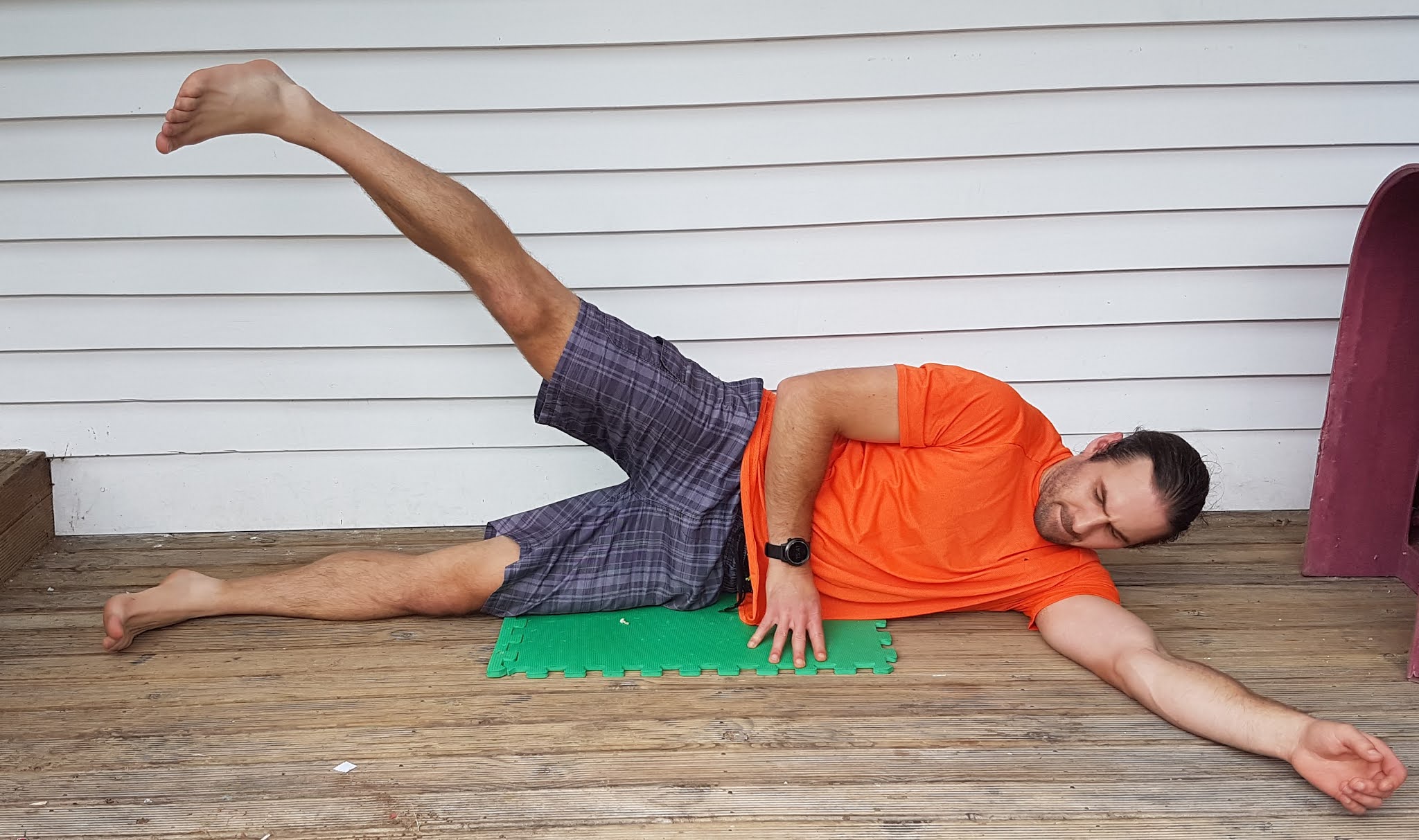
Another simple morning workout I tried only took an extra 5 minutes before I left for work. Tim Ferriss call these “Jane Fonda’s” in ‘Tools of Titans’, its Ryan Falherty’s 7 way hip. This ‘warm up’ is 7 different movements, 10-20 reps each, done in succession on one side, and then the next. Each movement hits the external rotator in the hip/glute area and can really get it burning.  This sequence is set up as a warm up/pre-hab for running, helping knee stabilization by strengthening the hips. I found this sequence very tough, but short enough to push through and it’s worth putting in the effort for the amount of train running I do. I also noticed some quick endurance gains on this workout which also carried over to some of my gymnastic training. I highly recommend giving this a go.

These don't look like much, but it burns by the end of the set.

A similar idea to the 7 way hip for me was to get in some volume in the mornings of hindu squats as a form of knee prep/pre-hab. I would do 3-4 sets of 20 hindu squats, super set with toe lifts (lift the big toe only, then the little toes, not moving the big toe). This was a really good morning warm up for my knees. Although when my knees were inflamed I wasn’t able to do these.

Hindu squats are great if pain free

The gymnastic bodies stretch course is a morning workout I keep attempting, as it’s a good morning wake up and nice to start the day limber. However, these courses are on the long side (40-45 minutes), and get super tough by the end. Well worth doing, but I find it hard to get in the head space for such hard stretching so early in the morning. I really should do more, I just dislike stretching.

My stretching needs more focus

Ideally every day would start with a walk or some stretching, or possibly some pre-hab knee work, but if I can manage a couple days per week, I’ll call it a win. Aim to get a little better every day (or every week). I hope this has given you some ideas for short, simple working movements to add into your movement practice.   


Saturday, 27 February 2021

Plate loaded backpack.

20L jerry can
I first heard about this style of loaded pack on a Joe Rogan podcast (I can’t remember which episode) and looked it up right away. I enjoy weighted hikes as I think they are excellent training in their own right and are overlooked for how important they are to prepare for longer hikes. So seeing this simple plate loaded backpack I was keen to acquire one for my own training.

The pack is really quite simple; it’s an old-school army ALICE pack with a bar on the back for loading plates. I bought a re-creation frame and straps from an army surplus store and drew out what I would need for the plate loading. The plate on the back is 200mm x 350mm and 3mm thick, the pipe is a standard 50mm pipe, 180mm long at approximately 70 degrees. I had this all welded up at an engineering shop next door to where I work. I can’t remember what I paid, but it wasn’t much, it’s ridiculously easy for a metal work shop to put together so I suspect most shops would be open to a cash deal.

With the plate made it was up to me to fix it to the pack frame. I bought four small U bolts from a hardware store, then marked and drilled where I would need them to go. I needed to cut down the top set as these would rub against my plates when loaded. The bottom bolts wouldn’t reach the plate due to the angle. I normally use one small spacer off this plate to allow the plate to sit well (Two spaces are pictured to make room for the bag below, more on that later). I finished the plate with silver zinc spray paint to prevent rust.

Total unloaded weight is 5kg (the steel is heavy) and I could load up 50kg plus on this frame.

A few modifications

One option is to ditch the plate loading and just load up the pack frame. I bought a shelf off a retailer in the US for about $5 which makes it easy to load containers to the pack. I bought a 20 litre jerry can for this purpose so I can load 20kg for water on the pack, roping or strapping it on. This works great as a slightly unstable load (a good proxy for hiking where the load is more fixed and the terrain more unstable). However this looks a little too “play army” for me so I don’t often train this. (Full respect to the armed forces, I’m just not part of them and don’t want to mistaken for a serviceman).

The shelf also makes it easy for me to attach a small carry bag to the pack which I set up when I take my dog out for longer walks where he will need a drink. I needed somewhere to pack some water for him and me, a dog bowl, raincoat, first aid kit etc. To make room for the shelf, and full pack I needed to pack the plates out from my back a little further, hence the extra packer.

Last but certainly not least are the straps I have for this pack frame. They are made by a New Zealand company (Twin Needle and Thread) and they are incredible. They are thick, wide, comfortable and extraordinarily well made. They make this my most comfortable pack by far, and I couldn’t be happier with them. The small pack is also made by them and it is of the same supreme quality. They were even able to custom make the pack for me with molle webbing on both sides.

This project took a little bit of organisation to collect all of the parts and put it together but has been well worth it for me. This is my go to set up for taking the dog for a walk around the block, exercising him, and me at the same time. This keeps me partially prepared for when I can get away for a longer hike.

Also good for weighted calisthenics

Sunday, 21 February 2021

Door knob climbing holds

Inspired by ninja warrior I always keep my eyes out for potential climbing holds/ odd “fitness” equipment. With this in mind I spotted these 6 old door handles in the store room at work. They are internal ‘orbit’ (i.e. round) door handles which were missing all the other parts, which was fine by me, I only wanted the handles. So when the time came for a big clean out of the store room, I was able to liberate these handles from the skip bin.

These were a little bit tricky to work with since they were obviously not built to be climbing holds. For one thing, the back of the handle is meant to fit over a large hole in a door. I used some scrap plywood to build a base, and drilled a centre hole to accommodate the back of the handle. In addition, there were parts of the handle that stuck out the back side, which I needed to drill space for as well. This is what makes the base look like Mickey Mouse. With the base built, I used some medium size tek screws (an extra beefy screw) to mount the door knobs next to my campus/hang board.

Finished base and tek screw

The handles are quite tricky to hang on and take quite a bit of odd grip strength to work with. They only rotate about 45 degrees right or left, so not a lot of spin, but the turning doesn’t really seem to be a factor in the difficulty of these grips. Also your fingers can run into the screws a little, so the fixing isn’t quite perfect.

All set up

Honestly these will probably get very little use as I don’t see them being worked into my current training program, however they were free and a bit of fun. It’s always worth keeping your eye open to find something fun for your gym/training space.


Sunday, 14 February 2021

My knee

My knee has been such a leading issue in my training the previous year that I think it needs its own post to lay out the whole story, and to fill in the blanks in other posts with my many references to ‘my knee’. This post might even give you some idea for dealing with your own injuries.

Going back 16 years (to the age of 16), I broke my ankle. It took quite a bit of physiotherapy to get it moving again; I only ever regained about 90% of its full ROM, and the foot arch was dead flat from that point on.

Fast forward a few years and I found I could wear vibram5 fingers with no foot pain (I was getting foot pain in most other shoes); however I did hyper flex the large toe on that foot (most likely because I was missing ankle ROM). This old injury can pop up every now and then too (Like during this beach hike).

Fast forward some more to around 2013, I injured the knee loading a truck at work. It was some sort of meniscus issue, eventually it calmed down but was never quite right after that. By 2016/2017 it got to the point where I decided I couldn’t jump hard anymore. Not that it would definitely hurt, but the risk was too high, if I did hurt it, the knee would be swollen for a week.

By 2020 it had been getting worse, it would hurt more often and I was struggling to figure out what was setting it off. Sometime it was just getting in or out of a car with ‘bad form’.

The knee prep series from Gymnastic bodies seemed okay while it wasn’t sore, but wasn’t possible if it was aggravated. Hindu squats and toe lifts (lift big toe only, then the other four toe only, not moving the other each time), were okay, but didn’t seem to help a lot. Ryan Flaherty’s 7 way hip (Google it, or check out Tim Ferriss' podcast) seemed useful to help stabilise the hip, but I got to the point where I felt like I could tick that off as “not the issue”. I tried various knee strengthening movements but I always felt like I was strong enough in all of them (nothing ever stood out as a weak point), and couldn’t find a standout which seemed like it was helping.

Then after my 69km run at the Blue Lake 24 hour run (there will be a full post on this) my knee was trashed (surprising I know). It took a long time to calm down and for me to find something that seemed to help. Currently I’m finding foam rolling (particularly VMO, IT band and quad) appears to be helping and getting me out of pain.

Before finding the foam rolling, I even went to a podiatrist and got a set for inserts to support my arches. These were hell the first week, but seem to really be working now. This was at odds with my natural method/ancestral health thinking, but I had to try something to get out of pain. I figured my foot was flat post injury and I wasn’t likely to ever to be able to fix it on my own so I needed help.

I can make and arch, but mostly it sinks
The next step this year in getting help is going to be seeing an Osteopath which a friend of mine has suggested. (Caveat – I don’t know of the science behind Osteopathy, but it looks like it will be some skilled manual therapy and a practised look at my mobility/positions/structure. I don’t see much downside here and a lot of potential upside) My current thinking is that 16 years of less than perfect loading has not been kind to my knee, so any help I can get to fixing this going forward I will be looking into.

One last thing at say here, when I started this blog nearly 10 years ago I would not have had the money to pay for a Podiatrist or Osteopath (maybe I could have got them at the time of injury under ACC but I was 16, and could have no idea how it would affect me in the future). So I totally understand not being able to afford this. If you are in a similar situation, I would suggest you do everything you can to get your feet right (Check out Chris Duffin - foot love), make sure your hips are strong, stretch and foam roll. Then if you’re still having trouble find a professional who can help, sometimes we need help.