Showing posts with label Lifestyle. Show all posts

Sunday, 14 March 2021

Yearly themes

We all know New Year’s Resolutions suck. I don’t need to explain why picking an arbitrary date in the future (the first of January), isn’t a great way to make a lasting change to your life. Nor is it a good idea to set a big goal for the year, which will take most of the year to achieve. It’s too hard to track progress, stay on track, and finally to actually complete a goal. It had been my goal for several years in a row to complete 5 sets of 5 pistol squats. But every year I would get side tracked, not put in the work required, and would eventually ‘fail’ at my goal. (Note: goals are very important but they need to be SMART – see Chris Duffin’s video for more)

The question then stands “What to do instead of New Year’s Resolutions?” I stumbled upon a good alternative, without quite knowing what I had two years ago. Having listened to a lot of the Jocko podcast, the term “Get it done” embedded deep in my mind. I felt like that would be the perfect ‘phase’ for my year. My daughter was about 6 months old at the time and I was trying to find/create a new routine for myself. The particular issue I was having was that I would leave small jobs un-done, leaving them to be done in a rush at a less ideal time. I wanted to get into a routine of doing the dishes, washing, packing my lunch and generally cleaning/tidying in the evening before bed, so all jobs were done before the morning. Sounds simple enough, but how’s the resolution to “be more organised” going for you? Not well I suspect. A much more useful option for me was to say in my head “get it done”, it sounds so simple, and yet it was extremely effective. It was also helpful to bring me back on the path when I slacked off.

After the first year of having a yearly “phrase” I discovered why this worked so well. I had inadvertently been using a yearly theme. CGP grey explains why a yearly theme is so beneficial in his video here, and it is well worth watching.

Some of the non-fiction

And some of the fiction

Given the successes of 2019’s phrase, my phrase for 2020 was “Put in the work” (again inspired by the Jocko podcast). To me this separated out into two parts of my life to focus on. The first was my workouts; I struggled to get my workouts on track in 2019. In 2020 I wanted to get back to regular workouts, and in particular to build up my strength endurance for gymnastic bodies (I’ve written before about my workout plan). So “put in the work” got me out into the gym getting my workout in, especially the extra volume. The second part of this phrase was for me to do more reading in 2020 (Covid really help out this goal). Originally, I had planned to read 12 books (Setting a number on a goal like this generally isn’t particularly helpful), and I eventually read 52 books that year. There was a mix of young adult (The Mortal Engines quartet was my favourite) and general non-fiction (‘When breath becomes air’ was so powerful and beautifully written that when I finished it I when straight back to page 1 and started reading again).

This year’s phase/theme is “Do all then things” (Odd I know, but it speaks to me and that’s the important part). This (hopefully) builds on the success of the previous two years. I want to get back into being efficient and getting things done around the home, and continue the progress I made in my workouts. I also what to build on the work I put in reading so widely, by beginning writing again (so far so good). I love to hear if this post helps you come up with a yearly phrase or theme, and later how you go with it.

Sunday, 7 March 2021

Morning Movement/Workouts.

I’m not much of a morning person, and definitely not a morning exerciser. A typical morning for me starts at 6:30am. I get up after hitting snooze several times; make coffee and bacon for a quick breakfast then sit down to watch a 20–25-minute minecraft let’s play video. It’s a little bit odd, I know, but it makes for a relaxed start to the day. Obviously this morning routine leaves a lot of room for improvement. For the last year I’ve been trying out some different simple morning workouts, by getting up only 5 - 30 minutes earlier. My only condition was that it couldn’t be so strenuous that it required a morning shower as we had a long season of water restrictions this past year. I wasn’t looking for major strength or endurance gains; mostly I was looking for a little morning movement/mobility.

By far the easiest and most successful morning workout was a 25 minute walk. I was listening to a back episode of the UMSO podcast when a 20 minute walk was mentioned as a good method of fat loss, so I decided to give it a try to lose a couple of kilos. This was extremely easy, just get up 30 minutes earlier; go for a walk around the block while listening to a podcast. I normally did this around 4 times per week, and lost about 2kg during that time.

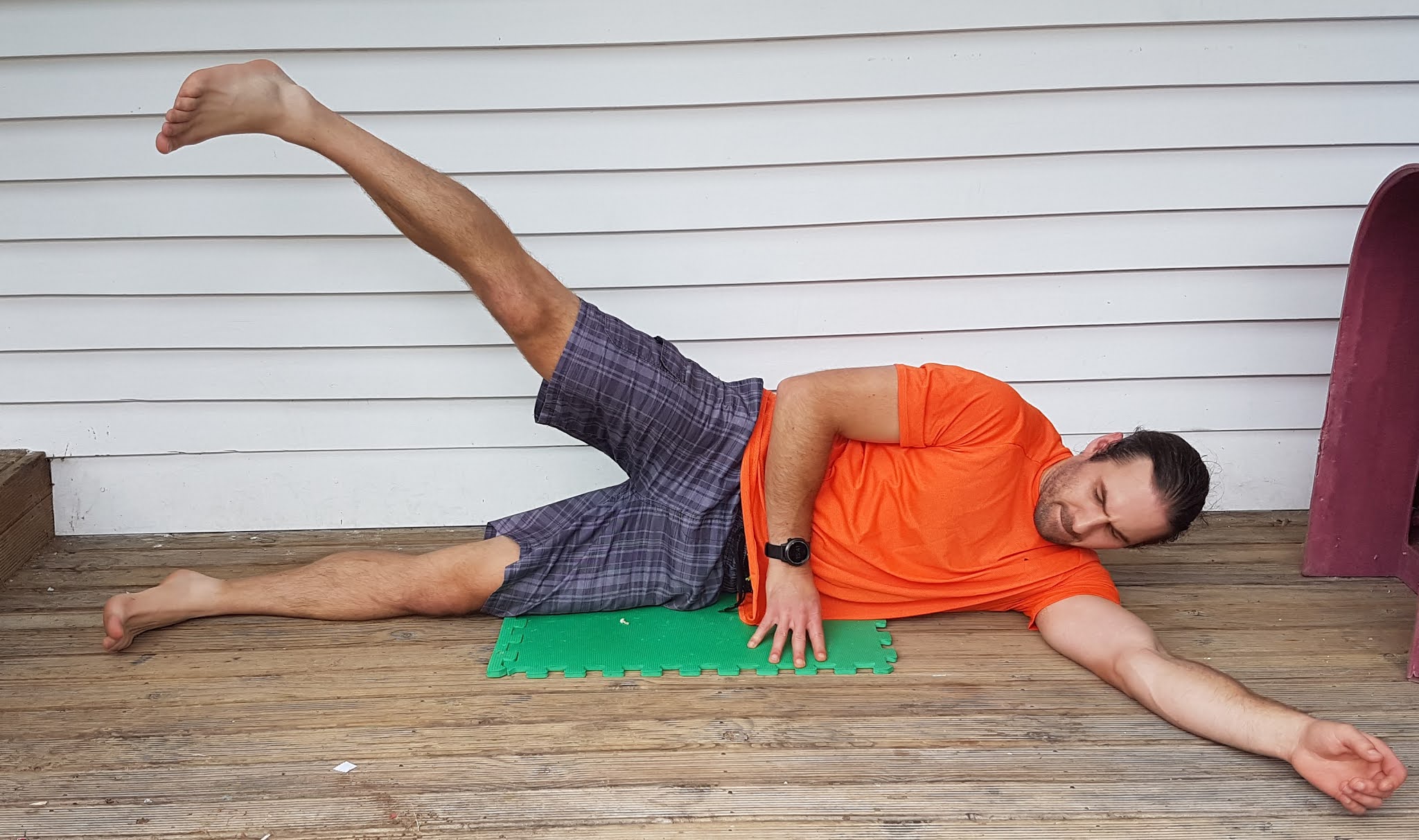
Another simple morning workout I tried only took an extra 5 minutes before I left for work. Tim Ferriss call these “Jane Fonda’s” in ‘Tools of Titans’, its Ryan Falherty’s 7 way hip. This ‘warm up’ is 7 different movements, 10-20 reps each, done in succession on one side, and then the next. Each movement hits the external rotator in the hip/glute area and can really get it burning.  This sequence is set up as a warm up/pre-hab for running, helping knee stabilization by strengthening the hips. I found this sequence very tough, but short enough to push through and it’s worth putting in the effort for the amount of train running I do. I also noticed some quick endurance gains on this workout which also carried over to some of my gymnastic training. I highly recommend giving this a go.

These don't look like much, but it burns by the end of the set.

A similar idea to the 7 way hip for me was to get in some volume in the mornings of hindu squats as a form of knee prep/pre-hab. I would do 3-4 sets of 20 hindu squats, super set with toe lifts (lift the big toe only, then the little toes, not moving the big toe). This was a really good morning warm up for my knees. Although when my knees were inflamed I wasn’t able to do these.

Hindu squats are great if pain free

The gymnastic bodies stretch course is a morning workout I keep attempting, as it’s a good morning wake up and nice to start the day limber. However, these courses are on the long side (40-45 minutes), and get super tough by the end. Well worth doing, but I find it hard to get in the head space for such hard stretching so early in the morning. I really should do more, I just dislike stretching.

My stretching needs more focus

Ideally every day would start with a walk or some stretching, or possibly some pre-hab knee work, but if I can manage a couple days per week, I’ll call it a win. Aim to get a little better every day (or every week). I hope this has given you some ideas for short, simple working movements to add into your movement practice.   


Sunday, 14 February 2021

My knee

My knee has been such a leading issue in my training the previous year that I think it needs its own post to lay out the whole story, and to fill in the blanks in other posts with my many references to ‘my knee’. This post might even give you some idea for dealing with your own injuries.

Going back 16 years (to the age of 16), I broke my ankle. It took quite a bit of physiotherapy to get it moving again; I only ever regained about 90% of its full ROM, and the foot arch was dead flat from that point on.

Fast forward a few years and I found I could wear vibram5 fingers with no foot pain (I was getting foot pain in most other shoes); however I did hyper flex the large toe on that foot (most likely because I was missing ankle ROM). This old injury can pop up every now and then too (Like during this beach hike).

Fast forward some more to around 2013, I injured the knee loading a truck at work. It was some sort of meniscus issue, eventually it calmed down but was never quite right after that. By 2016/2017 it got to the point where I decided I couldn’t jump hard anymore. Not that it would definitely hurt, but the risk was too high, if I did hurt it, the knee would be swollen for a week.

By 2020 it had been getting worse, it would hurt more often and I was struggling to figure out what was setting it off. Sometime it was just getting in or out of a car with ‘bad form’.

The knee prep series from Gymnastic bodies seemed okay while it wasn’t sore, but wasn’t possible if it was aggravated. Hindu squats and toe lifts (lift big toe only, then the other four toe only, not moving the other each time), were okay, but didn’t seem to help a lot. Ryan Flaherty’s 7 way hip (Google it, or check out Tim Ferriss' podcast) seemed useful to help stabilise the hip, but I got to the point where I felt like I could tick that off as “not the issue”. I tried various knee strengthening movements but I always felt like I was strong enough in all of them (nothing ever stood out as a weak point), and couldn’t find a standout which seemed like it was helping.

Then after my 69km run at the Blue Lake 24 hour run (there will be a full post on this) my knee was trashed (surprising I know). It took a long time to calm down and for me to find something that seemed to help. Currently I’m finding foam rolling (particularly VMO, IT band and quad) appears to be helping and getting me out of pain.

Before finding the foam rolling, I even went to a podiatrist and got a set for inserts to support my arches. These were hell the first week, but seem to really be working now. This was at odds with my natural method/ancestral health thinking, but I had to try something to get out of pain. I figured my foot was flat post injury and I wasn’t likely to ever to be able to fix it on my own so I needed help.

I can make and arch, but mostly it sinks
The next step this year in getting help is going to be seeing an Osteopath which a friend of mine has suggested. (Caveat – I don’t know of the science behind Osteopathy, but it looks like it will be some skilled manual therapy and a practised look at my mobility/positions/structure. I don’t see much downside here and a lot of potential upside) My current thinking is that 16 years of less than perfect loading has not been kind to my knee, so any help I can get to fixing this going forward I will be looking into.

One last thing at say here, when I started this blog nearly 10 years ago I would not have had the money to pay for a Podiatrist or Osteopath (maybe I could have got them at the time of injury under ACC but I was 16, and could have no idea how it would affect me in the future). So I totally understand not being able to afford this. If you are in a similar situation, I would suggest you do everything you can to get your feet right (Check out Chris Duffin - foot love), make sure your hips are strong, stretch and foam roll. Then if you’re still having trouble find a professional who can help, sometimes we need help.

Monday, 8 February 2021

My current workout program

2020 was the year of the pistol squat
I thought it would be worth writing up my current workout plan which I have been running for roughly a year now. The main thing to mention up front is that this program is not the optimal way of doing things. The exercise selection, sets and reps, timing, energy systems etc, none of this has been optimised. There is currently no periodisation. This is not my version of a secret sauce, become batman/mega athlete program. That is all to say if you are looking to design a program, this is not a template, only a rough collection of ideas.

So what’s the point, why this program? The point is I will do this program. I can, and will follow it for weeks on end, actually get something done, and move the needle forward. This is the most important point - the best program is the one you will do. So I’ll lay out what I’m doing and why, as there might be some useful information here for someone looking to build their own program to follow.

The what, how’s and why’s

The central feature of this plan was to put in a lot of gymnastics volume, working on muscular endurance. This is something I struggle with, and which always held me back when working on the gymnastic bodies (GB)programs. Secondary to this was to try and at least maintain some of the other movement in the GB program. I only have about 30-45 minutes max during my prime workout time to get things done, so no there is time for extras like grip work or conditioning (Eventually I will work this sort of thing back in, but not yet)

So the first feature of my program - Day one is Monday. I’ve rested during the weekend, and I’m most likely to have time and desire to train on Monday. The things I most want to get done go here. But, if life gets in the way for any reason, I bump this workout back to Tuesday or even Wednesday. That way, if only one workout gets done in a week, it’s the main workout.

Monday:

A: GB Front lever progressions (Hollow rock progression)

B1: Ring row, aiming for 5x15

B2: Push up, aiming for 5x20

B3: Shoulder dislocates, sets of 5

B4: Deadlifts 5x5 at 80kg

C: GB planche progression

A little breakdown is necessary here. It isn’t ideal to start a workout with difficult core work, but I am terrible at these progressions; so it’s best for me to do them first to get the work in. The push ups and ring rows are the main muscular endurance work here and I started by aiming for 5x10 and 5x15 respectively, adding reps where I could. I’m nearly at a point where 5x15 and 5x20 will be my new standard. My plan is to keep this at a maintenance point for some time, while I push more energy into the core and planche progressions. The shoulder dislocates are a good movement to cycle in during upper body work, I suggest applying these liberally. The deadlifts are currently just to give me a little volume to help out my squat, and the plan is to get to 5x5 at 100kg. I’m keeping these very light, as these are not the main point of the workout and I don’t want them to detract for the rest of the workout. The planche progressions are currently maintenance, but I plan on pushing to improve these later this year. This whole workout takes me about 40 minutes, so right on the maximum amount of time that I have available.

Many, many push ups

Tuesday

A: GB Side lever progression (Core based movement)

B1: Front squats 5x5 at 50kg

B2: Arch ups, aiming for 5x10

B3: Wrist prep sequence

The side lever progressions are another tough one for me as its all core work, but again, putting it first and early in the week has meant I’ve been about to make progress on it over the year. The front squats are technique work as I’m not great at them. The plan is once I can do them at 80kg with good form to switch to overhead squats as the technique work here. Front squats and eventually overhead squats will probably take the place of deadlifts on Monday at some stage. The arch ups (an extreme version of a hyper extension) are a low back exercise from gymnastic bodies which I think is extremely valuable for lower back prep work. The plan here is to get back to doing the twisting arch ups then maintain them (these are what I would call a moderately advanced low back strength movement – proceed with caution). The wrist strengthening sequence is out of the GB handstand series, google around and you’ll find something good to follow. These are well worth including in your program for injury prevention. This workout normally takes a little over 30 minutes, so there is room for me to add something at a later point in time.

Wednesday

Wednesdays are tricky as I have my young daughter with me in the gym, so it needs to be something toddler safe, so this is kind of a work in progress (I used to do Thursday’s workout here, but it just wasn’t working out)

A1: GB handstand work

A2: Knee prep sequence

This has been the workout which most often gets dropped out. I’m least interested in the handstand work right now, and lately my knee has been giving me a lot of trouble making the knee movements too painful (I have a post in the works outlining my knee trouble). For reference the knee prep is several movements involving loading the knee in different ways, including different twisting movements from the GB program (Have a google around if you are interested).

Thursday

I’m really enjoying this workout which is a follow on from my lockdown program. This is my “add one rep” workout. (I have a whole post on this workout, so I’ll be brief here).

A1: Pistol squats

A2: Natural glute-ham curls (very big assist from the hands)

A3: Pull ups

A4: Ring dips

I started this as 5 sets of 5 adding a rep every week; working towards 10x5, then the final goal is 10 sets of 10. The glute-ham curls are only 5x5 (the first 5 sets), and eventually I’ll switch them out for a full glute-ham raise. After the 5 sets of glue-ham raise, I’ve been switching to working on hollow rocks and arch body holds, currently its only around 3x12 (reps/sets) but the goal is to work towards 5x60. This may not be totally possible, but putting in the work will be helpful. Each round takes just under 5 minutes, and I am currently closing in on 8x5, so approximately a 40-minute workout. Thursday works well for this workout since it’s far enough away from Monday/Tuesday’s strength work (In both directions), so I can push hard and get some good work in.

Pistol squat, pull up, ring dip

Friday

Day off, generally I’m pretty worn out by now, and I have a lot to get done on Friday’s.

Saturday

Most of the time Saturday is a 10km road run, but whenever possible I prefer a trail run. 

Out for a training run
Sunday

For the last little while Sunday has been 5 sets of 5 heavy back squats, currently at 120kg. The goal here is to slowly and carefully push my max squat up. Heavy squats had been done on a Monday, but they got too heavy with the rest of the work happening on a Monday. Not sure how long I will keep the heavy squats here, but its working for now.


What I’m Missing.

A big thing I’m missing here is stretching, I’m trying to get up early to get some early morning stretching down, but it’s a struggle (I have a whole post in the works discussing AM workouts).

I need more stretching

Also missing is BJJ, previously I was aiming for Tuesday and Thursday, but energy levels with a new child was difficult, and 2020 was not the year for physical contact in large groups. The plan is to get my act together for a better 2021.

So that’s my current workout program. Hopefully there are some useful ideas in there for you. Adapt what is useful, reject what is useless and add what is specifically your own.

Saturday, 23 January 2021

My lockdown workouts

“What stands in the way becomes the way” – Marcus Aurelius

The New Zealand Covid-19 lockdown started on Wednesday 25th March 2020 and ended on Monday 27th April 2020 (roughly 5 weeks in level 4 lockdown). I had started a pre-planned week’s holiday on the Monday 23 March. I could see that a lockdown was probably on its way, so I started my lockdown workout that Monday. I wasn’t privy to any special information, it was a good bet were we heading to a lockdown given the way other countries were handling their more advanced outbreaks.

I saw a lockdown as an opportunity to get a lot of volume into my training, particularly to work on pistol squats which I had always struggled with. With pistol squats on the plan, I thought about what else I might add. I always enjoy pull ups and wanted to increase my max set (Here is a link to my outdoor pull up frame). With a pulling movement picked out I wanted to add a pushing movement. Push ups were an option, so were handstand push ups, but dips for me are approximately the same difficulty as pull ups, so they became the third movement. I considered adding ab wheel roll outs or hollow rocks, but thought that might end up being too much, or that the core work would negatively impact the other three movements.

Pistol squats, with and without a heel raise

With three movements chosen the next step was to plan the program - the sets, reps and days. I had Pavel’s grease the groove in mind when I decided to do one set, on the hour, for 10 hours each day (7 or 8am till 4 or 5pm). Note: I haven’t read the book for a long time, so I’m not sure my plan exactly aligns with Pavel’s, but the concept is similar. This workout plan was in addition to my normal workout routine (which I will also post about soon).  This meant I had to be fairly conservative with the total volume. This is an important point, if you are planning to add something like this hourly workout while still continuing your normal workout the volume can catch up on you quite quickly.

Pull ups and dips are a good pair

Starting on the first Monday I did 3 reps of each movement, 10 times per day Monday-Saturday, with Sunday as a rest day. This was 30 reps per day, per movement, plus whatever my regular workout was. Each set took less than 5 minutes. This first week went really well, pull ups and dips were fine, and I was starting to accumulate a lot of good pistol squats (with and without using a heel raise). Week two I increased the reps to 4 per hour, a total or 40 per day. Again things went well.

On Monday of week 3 I went up to 5 reps, 50 total per day. This is where the wheels fell off. Tuesday and Wednesday I was too burnt out for a workout of any kind, I had reached and exceeded my limit of volume in the last two weeks. After taking some time off, I tested my max pull ups on Friday and did 18, a new personal best, up from 17, so I guess the plan was a success.

Week 4 of lockdown I was able to do a full week of 5 reps each hour of pull ups and dips, 3 reps per hour pistol squats. I dropped the reps for the pistols down since I was able to switch to full sets of pistols with no heel raise, which I considered a huge win. I also felt that increasing the volume of pistol squats would be extremely difficult, and would likely lead to a lot of failed reps. I wanted the focus to be on better technique above all.

One major issue I found with this workout was increasing upper back tightness and pain. The huge volume (volume is of course relative to the individual) of pull ups was a lot of strain for my back and I was really feeling it. Not injured, just hurt.  Every house I added in some scapular and lat movements/stretches from the Gymnastic bodies program. Adding the stretches helped get the pain down and keep it at bay, but it was still a lot of volume. The other issue was the burnout in week 3. Both of these problems would have been mitigated with a slower progression, but I had planned for the 3,4,5 progression and wanted to stick with it, since the lockdown was only meant to be 4 weeks. If I could go back and change it I would try 3,3,4,4,5.

While the program didn’t go exactly to plan, I did achieve a good outcome. I got much better and more consistent at pistol squats, max pull ups went up, and I got in a lot of dip volume too. If you are ever in a situation where you can spare 2-5 minutes per hour for a few reps, maybe give this style of workout a try.

Note: Both my wife and I worked from home through lockdown.  Although we also have a toddler at home so only one of us could work at a time so the other could take care of our toddler.  My work allowed my flexibility to steal 5 minutes an hour in the garage; and my toddler often enjoys joining me in the gym. I know this won’t work for everyone, but it’s worth keeping in mind as an option or idea.

Saturday, 9 January 2021

I’m Back

Yes, that’s right, I’m back to writing after nearly three and a half years off.

From a 40km 'training' run

I guess I should explain the name change first. The old name (Back to primal) was never something I felt suited me, but it was the only name I could think of at the time which put together some of the themes in my thoughts. Both the natural method and a more ancestral view of health and fitness (Paleo/primal diets etc) were central to my journey at that stage. While I still feel strongly connected to these two themes, they are less central to my own path now; not to say they won’t take a greater role again in the future.

For a long time now I have thought of myself as an enthusiastic amateur (so much easier to say than to spell for a dyslexic like myself). I love getting stuck into a topic or pursuit as an amateur. I’m there to have fun, improve myself and learn new things, without needing to compete at a high level or ever be the best at a thing. This is how I feel about gymnastic strength training, powerlifting, trail running and Brazilian jiu jitsu. So the change of name makes it a bit easier for me to write about these different topics, without feeling like I have to keep tying them back to the natural method or ancestral health and fitness.

So, what have I been up to for the last three years? The biggest change in my life has been having a child (figure of speech, really it was my wife who had the baby). As of writing (Jan 2021) I have a two and a half year old daughter.  I have spent the last three years trying to figure out what my new ‘normal’ routine is before everything changes on me as our child grows.

So with that said the last three years have been a strange time for me fitness wise. I have continued to train as I can, with the time and energy available to me. I have some posts to write discussing what I chose to focus on, and the how and why of it. I have been enjoying trail running, the more difficult the better, including 24 hour and ultra distance events (as an enthusiastic amateur).  I’ve been able to maintain, or slightly increase my general strength, I can knock out good sets of 5 pistol squats, my back squat is the best it has ever been (5x5 at 120kg) and a max set of 18 pull ups. While these numbers are not in any way ‘impressive’ I consider them to be a good base level of strength for a generalist.  I also received my blue belt in Brazilian jiu jitsu (I will mention this very infrequently; as a blue belt I have very little of value to add to the internet about jiu jitsu other than to say it is well worth trying out).

Going forward, I’ll write up some of the more interesting things I been up to in the last few years and will continue chronicling my trail running and hiking adventures. I like to test my limits in the most extreme ways that I can, so expect to see fastest-know-time attempts and challenge runs that I set for myself, as well as the training and preparation for these challenges. I also have a few more homemade pieces of equipment I have made, which I will write posts on.

Stay tuned from more regular posts, weekly is the plan but I’ll see how that goes.

Hiking the Tongariro Northern Circuit

Sunday, 11 June 2017

Escape the Zoo?


Making my escape? Not likely.
Escape the Zoo; it’s something I had as a signature on a forum many years ago. I doubt I came up with it, but I cannot remember where I heard it. It comes out of the idea that we’re living in a zoo, of our own making, but a zoo none the less. We live in a strange, sterile environment, made of artificial materials, eating industrial foods we’ve never seen before, like zoo animals. We built our own cage.

The younger me heard this analogy and thought instantly of escape, I can walk around outside bare foot, go out into nature and. . . And what? Be free? How short sighted, I wasn’t free, I was looking out a window. Again I’m not sure if this is my own thinking, or someone else and I forgot where I first saw it, but my view point has since changed (Thinking some more and this can’t be my own thinking, I’m just not that switched on). We’re never getting out. For better or worse, we are stuck in a zoo. We’re not escaping, where would we go? The wild? What wild? We don’t have the space, let alone the skills to turn back and be wild. And even if we could, would we? Joe Rogan and Dr. Christopher Ryan argued this point, and I’m with Joe, the internet is awesome.

So we’re stuck in a zoo, which we built. It sucks, but there is hope. We built this place and we can make it better. Our environment is within our control. We just need to know how to change it, and have the motivation to change it. We need to eat better, check, we can do this. Trainers and handlers don’t feed us, we do. We don’t move enough, check, we can do this, start working out, in whatever way you can and take it from there. This also gets into the idea that this whole Paleo diet thing is not a historical re-enactment, but a logical framework with which to make some decisions.

We haven't escaped the zoo, but we have gone on a field trip outside its walls.

As a starting point for food, the basic Paleo/Primal diet is great, east mostly vegetables and meat, some fruits, nuts and seeds, avoid industrial foods (grains and vegetable oils). Pretty simple starting point, and you can go as deep as you like with this stuff but simple gets you a long way. Next would be movement. I really like Mark Sission’s suggestion of a lot of low level movement (walking), lift some heavy things and sprint a little. Variations on this work really well to regain a basic level of fitness. Again you can get way out into the weeds searching for optimal fitness, or high performance but these are topics for another day.

From there things get a little trickier and maybe the benefits get smaller (or more difficult to see). Sleep is a big factor, then digging deeper into diet and exercise. Community is a huge piece to address also.

This is all just the start. It’s about environment design. We are the designers, and the subjects. We won’t create perfect, but it is within our power to create better. I’m going to try and use this post as a jumping of point to explore areas of environment (lifestyle design) one small section at a time, so stay tuned for more.

This post has been largely influenced but so many people (mostly via podcasts). So if you want more check out Katy Bowman, Kelly Starrett, Daniel Vitalis, Rafe Kelly, Mark Sisson, Robb Wolf, Erwan Le Corre. Do a google search and start listening to any podcast with them on it, especially if it’s between two of them.

This might be a good example of using what the zoo has given us.

Sunday, 30 April 2017

Consistency, volume and frequency


This post is about getting better at something. Maybe you suck at it and want to get better, maybe you hate it, but it’s something you should do anyway, or maybe you’re just struggling to make progress.

For a great many things once a week isn’t enough. Trying to learn a skill, once a week practice won’t get you very far very fast. Trying to make a change (in your body or life) working on it once a week and ignoring it the other 6 days isn’t going to do much in the way of change. You’re basically wasting your time.

To make progress you (often) need at least twice a week, three times a week is possibly even better, four or more could be too often depending on what you are doing. Two examples of this that I have found is my shoulder mobility, and my wrist prep.

I had been working the wrist prep series from the gymnastic bodies’ handstand course once a week for a long time. There are four different exercises with multiple progressions. For three of the exercises I was able to make good progress, but one of them I was getting nowhere.  Every week was the same with very little observable progress. So I stepped it up to twice a week. Progress has still been slow, but it is there. I get observably better week to week. The element in question was more about gaining greater flexibly in my palm and fingers, stretching what must be quite tough muscle and connective tissue in the hand. Once a week was not enough to activate, and maintain a positive change in these tissues, but twice a week seems to be working. Three times a week might be better, and maybe I will try, but for now slow progress is still progress.

An example of slow but viable progress

I’ve written about my struggle gaining shoulder mobility before and some things that have helped in my post on the mobility stick. Another major help for increasing my shoulder mobility has been working in 2-3 times per week with multiple modalities. Previously I had been working shoulder mobility only once a week, with dislocates and another behind the back movement. I was getting better slowly, but not effectively. By adding in the shoulder and thoracic stretch routine weekly, and adding an additional day with the mobility stick I’ve been able to make slightly faster and more effective progress. I’m still far from perfect but I’m able to gain more mobility, and use the new range of motion more frequently during the week. 


In both cases it was not just consistently training these elements, but more frequency and more volume by adding a second training session. Often move volume is needed for better results, but be careful, stay withing recoverable limits or you'll do more harm than good.

If you want to make true change, once a week is not enough. If you care about something, focus on it, spend time on it. Start with one element you want to get better at, but are only working on once a week, and add a second day. Then re-evaluate, maybe add another day, or maybe pick another element which could use a twice a week scheduling. This way you are more likely to make these changes routine, trying to add too much all at once will burn you out physically and mentally and won’t create the change you’re after.

Sunday, 4 September 2016

When ‘stress eating’ can be helpful.


Always training hard
What I talk about in this post comes with a lot of caveats and reasons not to do what I’m suggesting. There are many situations where this won’t be appropriate and many people who this won’t be appropriate for; but it did seem to work for me so I thought it would be good to post about.

Let’s start back at the beginning 3 years ago. I was going back to University to study to become a teacher (didn’t work out but that’s a story for another day). The university I got into was over an hour drive away in traffic so I was going to have to get up at 5:30 am (I’m not a morning person) to get to my morning classes, then turn around and drive to work, then study, write assignments or prep for classes in the evening. In short I was going to be long hours with a lot of life stresses: early starts, late night, money trouble, grades etc. All on top for quite a hard training schedule as I was aiming for about 10 hours of training per week.

In thinking about how I would get through this I remembered on one of the Paleo solution podcasts Rob talked about a guy going through BUDS who just ate his way through with sticks of butter. While everyone else was losing weight, this guy put on several pounds which was unheard of during BUDS. This made me think, if I was going through a lot of stress, including stress from my workouts I could just eat my way through it, so that at the very least I could recover from my workouts. So in a way I should be able to mitigate that stress (or at least some of it). It went along with the idea that there is no such thing as over training, just under eating.

Now this is defiantly not a good idea if you have any disordered eating, if you have any past or present eating issues I wouldn’t suggest this. I would include regular stress eating in this category, there is no need to make that situation worse, since I’m suggesting this strategy for when times are really stressful. This also isn’t for competitive athletes or weight class athletes, this suggestion isn’t for you, also don’t get your advice from me, find someone more qualified. Also I’m only suggesting this to people who are training hard, I was pushing 7-10 hours per week of weights, gymnastics and two martial arts at the time. If you do some push ups and pull ups and run 5km in the weekend this isn’t for you. Generally if you have to ask, it’s not for you.

Peanut butter and dark chocolate, a favorite of mine.
Now for the what and how. The idea isn’t to just go off the rails are eat everything because ‘gains’. The goal is to eat just a little above maintenance all the time so that a lack of calories is never part of your life stresses. You should also stick to a paleo/primal type diet and not go off the rails since extra inflammation isn’t going to help matters either. For me I added a protein shake in the morning, and always had something around for an afternoon snack if I needed it (tuna or dark chocolate mostly). I was only adding a few hundred calories per day. Never eating too much but making sure I never went hungry.

The outcome of a year of this was no more than 5kg of weight gain, I don’t know exactly what the weight gain was because I never kept track of it, but it was definitely less than 5kg. I also started squatting and deadlifting that year as was about to build up to a 150kg squat and 200kg deadlift having never done either before. The important thing is that the scale weight doing up wasn’t a problem for me, and getting a little bit softer wasn’t an issue either. Just relax about those, there are more important things to worry about (job, study, life etc).

So after this year I was loosely is a mass gain phase and got up to around 88kg, but after some ups and downs I balanced out fairly naturally at around the 85kg mark. I’m currently keeping at about 80kg, which requires some discipline for me, but nothing extreme.

I would say this is worth considering for up to a year, maybe 18 months, but really not more than that. Any longer is also way to long in such a stressful time. I also wouldn’t suggest doing this yearly with cuts for summer (or competition), unless you have things really dialled in. That’s fine for competitive athletes, with less other life stresses, but throw in all kind of other life stresses as well as cutting and you’re in for a bad time.