Showing posts with label Working out. Show all posts

Sunday, 7 March 2021

Morning Movement/Workouts.

I’m not much of a morning person, and definitely not a morning exerciser. A typical morning for me starts at 6:30am. I get up after hitting snooze several times; make coffee and bacon for a quick breakfast then sit down to watch a 20–25-minute minecraft let’s play video. It’s a little bit odd, I know, but it makes for a relaxed start to the day. Obviously this morning routine leaves a lot of room for improvement. For the last year I’ve been trying out some different simple morning workouts, by getting up only 5 - 30 minutes earlier. My only condition was that it couldn’t be so strenuous that it required a morning shower as we had a long season of water restrictions this past year. I wasn’t looking for major strength or endurance gains; mostly I was looking for a little morning movement/mobility.

By far the easiest and most successful morning workout was a 25 minute walk. I was listening to a back episode of the UMSO podcast when a 20 minute walk was mentioned as a good method of fat loss, so I decided to give it a try to lose a couple of kilos. This was extremely easy, just get up 30 minutes earlier; go for a walk around the block while listening to a podcast. I normally did this around 4 times per week, and lost about 2kg during that time.

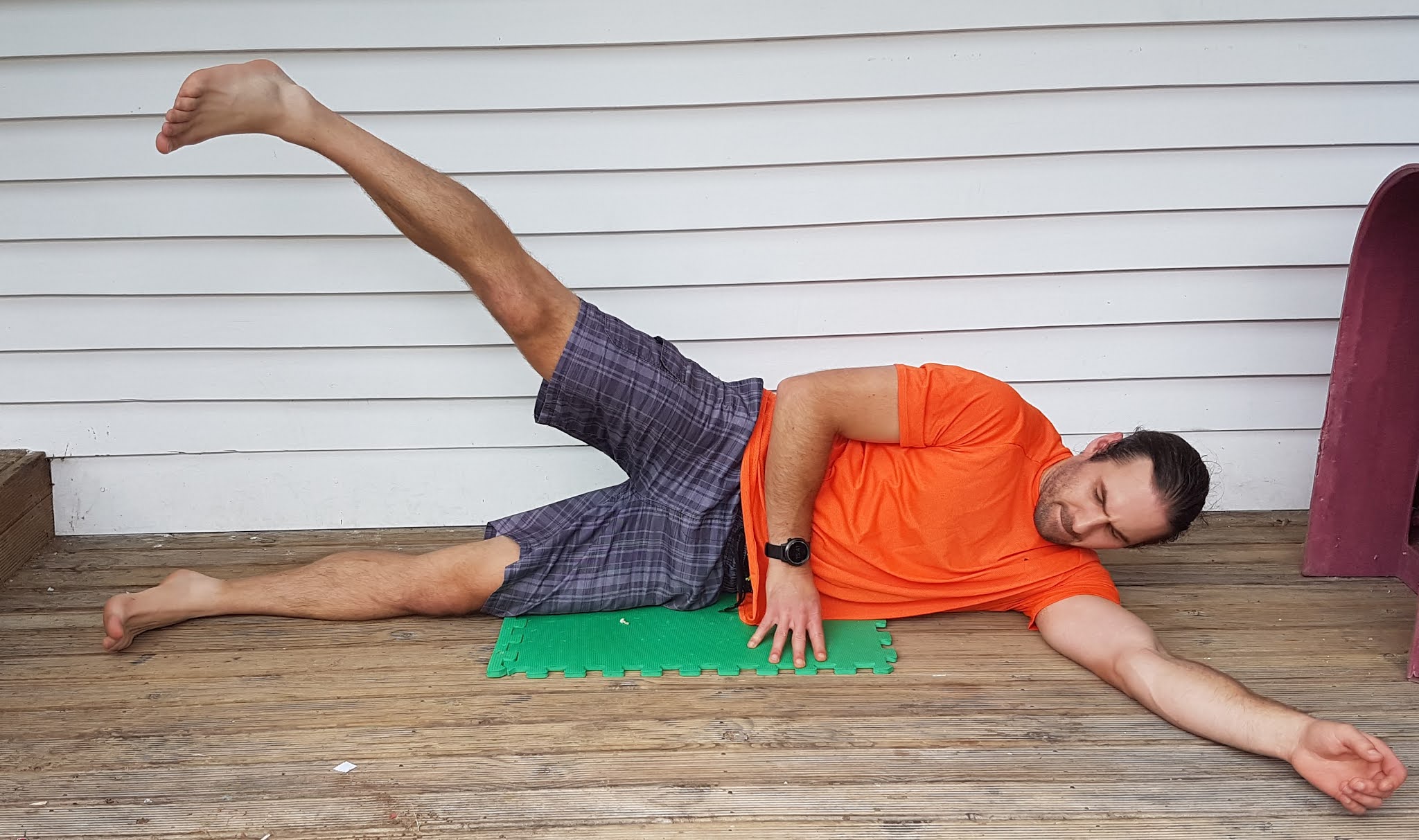
Another simple morning workout I tried only took an extra 5 minutes before I left for work. Tim Ferriss call these “Jane Fonda’s” in ‘Tools of Titans’, its Ryan Falherty’s 7 way hip. This ‘warm up’ is 7 different movements, 10-20 reps each, done in succession on one side, and then the next. Each movement hits the external rotator in the hip/glute area and can really get it burning.  This sequence is set up as a warm up/pre-hab for running, helping knee stabilization by strengthening the hips. I found this sequence very tough, but short enough to push through and it’s worth putting in the effort for the amount of train running I do. I also noticed some quick endurance gains on this workout which also carried over to some of my gymnastic training. I highly recommend giving this a go.

These don't look like much, but it burns by the end of the set.

A similar idea to the 7 way hip for me was to get in some volume in the mornings of hindu squats as a form of knee prep/pre-hab. I would do 3-4 sets of 20 hindu squats, super set with toe lifts (lift the big toe only, then the little toes, not moving the big toe). This was a really good morning warm up for my knees. Although when my knees were inflamed I wasn’t able to do these.

Hindu squats are great if pain free

The gymnastic bodies stretch course is a morning workout I keep attempting, as it’s a good morning wake up and nice to start the day limber. However, these courses are on the long side (40-45 minutes), and get super tough by the end. Well worth doing, but I find it hard to get in the head space for such hard stretching so early in the morning. I really should do more, I just dislike stretching.

My stretching needs more focus

Ideally every day would start with a walk or some stretching, or possibly some pre-hab knee work, but if I can manage a couple days per week, I’ll call it a win. Aim to get a little better every day (or every week). I hope this has given you some ideas for short, simple working movements to add into your movement practice.   


Monday, 8 February 2021

My current workout program

2020 was the year of the pistol squat
I thought it would be worth writing up my current workout plan which I have been running for roughly a year now. The main thing to mention up front is that this program is not the optimal way of doing things. The exercise selection, sets and reps, timing, energy systems etc, none of this has been optimised. There is currently no periodisation. This is not my version of a secret sauce, become batman/mega athlete program. That is all to say if you are looking to design a program, this is not a template, only a rough collection of ideas.

So what’s the point, why this program? The point is I will do this program. I can, and will follow it for weeks on end, actually get something done, and move the needle forward. This is the most important point - the best program is the one you will do. So I’ll lay out what I’m doing and why, as there might be some useful information here for someone looking to build their own program to follow.

The what, how’s and why’s

The central feature of this plan was to put in a lot of gymnastics volume, working on muscular endurance. This is something I struggle with, and which always held me back when working on the gymnastic bodies (GB)programs. Secondary to this was to try and at least maintain some of the other movement in the GB program. I only have about 30-45 minutes max during my prime workout time to get things done, so no there is time for extras like grip work or conditioning (Eventually I will work this sort of thing back in, but not yet)

So the first feature of my program - Day one is Monday. I’ve rested during the weekend, and I’m most likely to have time and desire to train on Monday. The things I most want to get done go here. But, if life gets in the way for any reason, I bump this workout back to Tuesday or even Wednesday. That way, if only one workout gets done in a week, it’s the main workout.

Monday:

A: GB Front lever progressions (Hollow rock progression)

B1: Ring row, aiming for 5x15

B2: Push up, aiming for 5x20

B3: Shoulder dislocates, sets of 5

B4: Deadlifts 5x5 at 80kg

C: GB planche progression

A little breakdown is necessary here. It isn’t ideal to start a workout with difficult core work, but I am terrible at these progressions; so it’s best for me to do them first to get the work in. The push ups and ring rows are the main muscular endurance work here and I started by aiming for 5x10 and 5x15 respectively, adding reps where I could. I’m nearly at a point where 5x15 and 5x20 will be my new standard. My plan is to keep this at a maintenance point for some time, while I push more energy into the core and planche progressions. The shoulder dislocates are a good movement to cycle in during upper body work, I suggest applying these liberally. The deadlifts are currently just to give me a little volume to help out my squat, and the plan is to get to 5x5 at 100kg. I’m keeping these very light, as these are not the main point of the workout and I don’t want them to detract for the rest of the workout. The planche progressions are currently maintenance, but I plan on pushing to improve these later this year. This whole workout takes me about 40 minutes, so right on the maximum amount of time that I have available.

Many, many push ups

Tuesday

A: GB Side lever progression (Core based movement)

B1: Front squats 5x5 at 50kg

B2: Arch ups, aiming for 5x10

B3: Wrist prep sequence

The side lever progressions are another tough one for me as its all core work, but again, putting it first and early in the week has meant I’ve been about to make progress on it over the year. The front squats are technique work as I’m not great at them. The plan is once I can do them at 80kg with good form to switch to overhead squats as the technique work here. Front squats and eventually overhead squats will probably take the place of deadlifts on Monday at some stage. The arch ups (an extreme version of a hyper extension) are a low back exercise from gymnastic bodies which I think is extremely valuable for lower back prep work. The plan here is to get back to doing the twisting arch ups then maintain them (these are what I would call a moderately advanced low back strength movement – proceed with caution). The wrist strengthening sequence is out of the GB handstand series, google around and you’ll find something good to follow. These are well worth including in your program for injury prevention. This workout normally takes a little over 30 minutes, so there is room for me to add something at a later point in time.

Wednesday

Wednesdays are tricky as I have my young daughter with me in the gym, so it needs to be something toddler safe, so this is kind of a work in progress (I used to do Thursday’s workout here, but it just wasn’t working out)

A1: GB handstand work

A2: Knee prep sequence

This has been the workout which most often gets dropped out. I’m least interested in the handstand work right now, and lately my knee has been giving me a lot of trouble making the knee movements too painful (I have a post in the works outlining my knee trouble). For reference the knee prep is several movements involving loading the knee in different ways, including different twisting movements from the GB program (Have a google around if you are interested).

Thursday

I’m really enjoying this workout which is a follow on from my lockdown program. This is my “add one rep” workout. (I have a whole post on this workout, so I’ll be brief here).

A1: Pistol squats

A2: Natural glute-ham curls (very big assist from the hands)

A3: Pull ups

A4: Ring dips

I started this as 5 sets of 5 adding a rep every week; working towards 10x5, then the final goal is 10 sets of 10. The glute-ham curls are only 5x5 (the first 5 sets), and eventually I’ll switch them out for a full glute-ham raise. After the 5 sets of glue-ham raise, I’ve been switching to working on hollow rocks and arch body holds, currently its only around 3x12 (reps/sets) but the goal is to work towards 5x60. This may not be totally possible, but putting in the work will be helpful. Each round takes just under 5 minutes, and I am currently closing in on 8x5, so approximately a 40-minute workout. Thursday works well for this workout since it’s far enough away from Monday/Tuesday’s strength work (In both directions), so I can push hard and get some good work in.

Pistol squat, pull up, ring dip

Friday

Day off, generally I’m pretty worn out by now, and I have a lot to get done on Friday’s.

Saturday

Most of the time Saturday is a 10km road run, but whenever possible I prefer a trail run. 

Out for a training run
Sunday

For the last little while Sunday has been 5 sets of 5 heavy back squats, currently at 120kg. The goal here is to slowly and carefully push my max squat up. Heavy squats had been done on a Monday, but they got too heavy with the rest of the work happening on a Monday. Not sure how long I will keep the heavy squats here, but its working for now.


What I’m Missing.

A big thing I’m missing here is stretching, I’m trying to get up early to get some early morning stretching down, but it’s a struggle (I have a whole post in the works discussing AM workouts).

I need more stretching

Also missing is BJJ, previously I was aiming for Tuesday and Thursday, but energy levels with a new child was difficult, and 2020 was not the year for physical contact in large groups. The plan is to get my act together for a better 2021.

So that’s my current workout program. Hopefully there are some useful ideas in there for you. Adapt what is useful, reject what is useless and add what is specifically your own.
Sunday, 24 January 2021

Lockdown Running

“What stands in the way becomes the way” – Marcus Aurelius

The New Zealand lockdown started on Wednesday 25th March 2020 and ended on Monday 27th April 2020 (roughly 5 weeks). Late in 2019 I had started to plan out my year of trail running for 2020. I wanted to peak for running 100km at the blue lake 24 hour event in September (post coming), and for a fastest known time (FKT) attempt of the Kaimai North-South Track in February (more details about this to come). My plan was to get in one big trail run per month. I was also choosing trails with a lot of elevation gain, ideally 1000m+.

After the FKT attempt in February I was ready to start my hard training runs in March, and was planning to run the Bell-Tahuanui track loop on Mt. Pirongia on Wednesday 25th March (I even took the whole week off work). But this was not to be; instead on the first day of my week off it was announced we were going into lockdown, I would be stuck at home for 5 weeks.

A note on how I treated the Lockdown: We knew that the stricter the lockdown, the shorter it would be. With this in mind, I only left the property for food shopping once per week, and to walk the dog on a 2km loop once per day. While there was nothing legal to stop me from running the roads near my home, I chose not to. This isn’t some weird form of virtue signaling, or boast of how difficult my lockdown was. I just found that by deciding to stay at home, I was able to limit the moral fatigue that comes with choosing to leave the house.

If there was a hill or staircase near my house I would have found a way to accumulate 1000m of elevation gain for a training run. However, the closest hill was in an adjacent neighborhood which I deemed to far to travel to. After seeing a Frenchman who ran a marathon on his balcony I planned to run laps of my house to get in my training. I wasn’t alone is this, and many people on local running groups were planning the same, some even set up virtual events.

I paced out my course at approximately 50m (I live on a small flat section, with a small house in the middle) To run a 5k would be about 100 laps, and a 10km would be about 200 laps. My usual training run would be a 10km run on a Saturday or Sunday, so instead of a road run I substituted laps around my house.

Round and round like a hamster wheel

My start and finish point was my back deck where I kept a drink and white board, recording every 10 laps. I would run 20-25 laps in one direction before reversing to run the opposite direction. This training was harder than I expected; even when I felt like I was running fast, my fitbit/strava still recorded it as a rather slow pace. The constant turning made it difficult to ever get up to a good pace. During the lock down I ran 7km (150 laps), 4.4km (100 laps), 10.7km (200 laps) and 2.6km (50 laps). I considered running a half marathon or even full marathon, but I didn’t want to sacrifice my pistol squat training program. I can run a half/marathon anytime, but I probably won’t get another chance at my pistol squat program.

While this wasn’t amazing training I did get to run which felt great and I could call it an achievement for the day. You don’t have to be in lockdown to do this either, channel your inner crazy person and find a ridiculously short track to run far too many laps of. It’s mental training to set an odd goal which is easily achievable and you get to make a small win for the day or week.

In costume for a virtual event


Saturday, 23 January 2021

My lockdown workouts

“What stands in the way becomes the way” – Marcus Aurelius

The New Zealand Covid-19 lockdown started on Wednesday 25th March 2020 and ended on Monday 27th April 2020 (roughly 5 weeks in level 4 lockdown). I had started a pre-planned week’s holiday on the Monday 23 March. I could see that a lockdown was probably on its way, so I started my lockdown workout that Monday. I wasn’t privy to any special information, it was a good bet were we heading to a lockdown given the way other countries were handling their more advanced outbreaks.

I saw a lockdown as an opportunity to get a lot of volume into my training, particularly to work on pistol squats which I had always struggled with. With pistol squats on the plan, I thought about what else I might add. I always enjoy pull ups and wanted to increase my max set (Here is a link to my outdoor pull up frame). With a pulling movement picked out I wanted to add a pushing movement. Push ups were an option, so were handstand push ups, but dips for me are approximately the same difficulty as pull ups, so they became the third movement. I considered adding ab wheel roll outs or hollow rocks, but thought that might end up being too much, or that the core work would negatively impact the other three movements.

Pistol squats, with and without a heel raise

With three movements chosen the next step was to plan the program - the sets, reps and days. I had Pavel’s grease the groove in mind when I decided to do one set, on the hour, for 10 hours each day (7 or 8am till 4 or 5pm). Note: I haven’t read the book for a long time, so I’m not sure my plan exactly aligns with Pavel’s, but the concept is similar. This workout plan was in addition to my normal workout routine (which I will also post about soon).  This meant I had to be fairly conservative with the total volume. This is an important point, if you are planning to add something like this hourly workout while still continuing your normal workout the volume can catch up on you quite quickly.

Pull ups and dips are a good pair

Starting on the first Monday I did 3 reps of each movement, 10 times per day Monday-Saturday, with Sunday as a rest day. This was 30 reps per day, per movement, plus whatever my regular workout was. Each set took less than 5 minutes. This first week went really well, pull ups and dips were fine, and I was starting to accumulate a lot of good pistol squats (with and without using a heel raise). Week two I increased the reps to 4 per hour, a total or 40 per day. Again things went well.

On Monday of week 3 I went up to 5 reps, 50 total per day. This is where the wheels fell off. Tuesday and Wednesday I was too burnt out for a workout of any kind, I had reached and exceeded my limit of volume in the last two weeks. After taking some time off, I tested my max pull ups on Friday and did 18, a new personal best, up from 17, so I guess the plan was a success.

Week 4 of lockdown I was able to do a full week of 5 reps each hour of pull ups and dips, 3 reps per hour pistol squats. I dropped the reps for the pistols down since I was able to switch to full sets of pistols with no heel raise, which I considered a huge win. I also felt that increasing the volume of pistol squats would be extremely difficult, and would likely lead to a lot of failed reps. I wanted the focus to be on better technique above all.

One major issue I found with this workout was increasing upper back tightness and pain. The huge volume (volume is of course relative to the individual) of pull ups was a lot of strain for my back and I was really feeling it. Not injured, just hurt.  Every house I added in some scapular and lat movements/stretches from the Gymnastic bodies program. Adding the stretches helped get the pain down and keep it at bay, but it was still a lot of volume. The other issue was the burnout in week 3. Both of these problems would have been mitigated with a slower progression, but I had planned for the 3,4,5 progression and wanted to stick with it, since the lockdown was only meant to be 4 weeks. If I could go back and change it I would try 3,3,4,4,5.

While the program didn’t go exactly to plan, I did achieve a good outcome. I got much better and more consistent at pistol squats, max pull ups went up, and I got in a lot of dip volume too. If you are ever in a situation where you can spare 2-5 minutes per hour for a few reps, maybe give this style of workout a try.

Note: Both my wife and I worked from home through lockdown.  Although we also have a toddler at home so only one of us could work at a time so the other could take care of our toddler.  My work allowed my flexibility to steal 5 minutes an hour in the garage; and my toddler often enjoys joining me in the gym. I know this won’t work for everyone, but it’s worth keeping in mind as an option or idea.

Sunday, 17 January 2021

Pistol squats - Heel lift progression

Using a small heel lift
My recurring goal for several years has been to complete five sets of five good pistol squats, but I could never quite manage it. The main issue was my left ankle, which is missing some ROM after a bad break when I was 16 years old. It was always a struggle to get enough ROM in that ankle, and to link that up with the specific proprioception and muscle firing to perform a good pistol squat on that side. With consistent, focused training I would make headway slowly, but it was always difficult to lock in the progress and achieve consistent pistol squats within and between sets.

There are endless articles and videos teaching the pistol squat and various progressions, but I’m going to focus on the one small progression that I got a lot of benefit from.  I haven’t seen the specifics of this progression discussed in this way before. If you are early on in pistol squat progressions I would highly suggest looking at Al Kavadlo’s work, and would consider reading his new book on the topic (I have not read it, but his work is always good). My specific progression technique worked for me because I had sufficient strength and balance, but was missing both a small amount of ROM and the muscular control at that end range. The lack of muscular control is because I have been missing that range of motion since I was 16 years old.

What I needed to do was practice the movement as close to the perfect position as possible to grease that groove. One option often used is to hold a weight out in front of you for a counter balance, then slowly reduce the weight to remove that assistance. I could do pistols with a 2kg weight, or even a 1kg weight, but the specific adaptions didn’t feel correct to drop the weight entirely.

Instead I tried using a very small heel lift (using a heel lift is a standard suggestion by most trainers). I was able to do full pistol squats with the heel lift compensating for my missing ROM. I started with a 7mm piece of plywood and could manage several reps quite well.

I wanted a system where I could very slowly lower the heel lift and therefor reduce the assistance for the missing ROM. One option would be a deck of cards, slowly removing cards, which is something I did consider. Instead I found some scrap acrylic sheet of various thicknesses. In fact, I dropped into a local acrylic product manufacturer and asked from some samples; they pointed me to their off cut bin and said take what I like. I found pieces approximately 5mm and 3mm thick. 

Scrap acrylic and plywood - Cost $0

Using these blocks I could warm up with 7mm, and then switch to 5mm for my main sets. Later when this was easy I could switch to 3mm during the middle sets, eventually performing pistols without the use of blocks. The trick here is getting in lots of good reps, as close as possible to the desired outcome. Now I just do my first 2 reps of a workout on the 5mm block, before my main working sets with no blocks.


The right hand picture shows me using a 5mm block, the position is almost identical, but slightly easier to hold. I am able to keep a straighter back as using the block requires less ankle flexion. 

Combined with this method was collecting many reps daily over our covid-19 lockdown, which I will discuss in detail in a further post. This allowed me to get to a point where I could do 5 sets of 5 pistol squats with what I would consider good form. I am constantly working for better form (particularly a straighter back) and better control but I am very happy with my progress. If you need something to help lock in good reps of pistol squats try a small heel raise and reduce this as you get better.

A note short note on pistol squats: I think pistol squats are a movement worth doing and they are worth working towards even if you can’t do one. The end range position is something important to train as it often comes up in nature (particularly when hiking or climbing in rugged environments). I’m not worried about a rounded back during pistol squats, as the back isn’t loaded, though I think it’s worth working to reduce the amount of flection. I think heavy back squats are great if you have access to the equipment and can do them safely.  I train both back squats and pistol squats.

If you have any questions feel free to leave them in the comments.

Sunday, 30 April 2017

Consistency, volume and frequency


This post is about getting better at something. Maybe you suck at it and want to get better, maybe you hate it, but it’s something you should do anyway, or maybe you’re just struggling to make progress.

For a great many things once a week isn’t enough. Trying to learn a skill, once a week practice won’t get you very far very fast. Trying to make a change (in your body or life) working on it once a week and ignoring it the other 6 days isn’t going to do much in the way of change. You’re basically wasting your time.

To make progress you (often) need at least twice a week, three times a week is possibly even better, four or more could be too often depending on what you are doing. Two examples of this that I have found is my shoulder mobility, and my wrist prep.

I had been working the wrist prep series from the gymnastic bodies’ handstand course once a week for a long time. There are four different exercises with multiple progressions. For three of the exercises I was able to make good progress, but one of them I was getting nowhere.  Every week was the same with very little observable progress. So I stepped it up to twice a week. Progress has still been slow, but it is there. I get observably better week to week. The element in question was more about gaining greater flexibly in my palm and fingers, stretching what must be quite tough muscle and connective tissue in the hand. Once a week was not enough to activate, and maintain a positive change in these tissues, but twice a week seems to be working. Three times a week might be better, and maybe I will try, but for now slow progress is still progress.

An example of slow but viable progress

I’ve written about my struggle gaining shoulder mobility before and some things that have helped in my post on the mobility stick. Another major help for increasing my shoulder mobility has been working in 2-3 times per week with multiple modalities. Previously I had been working shoulder mobility only once a week, with dislocates and another behind the back movement. I was getting better slowly, but not effectively. By adding in the shoulder and thoracic stretch routine weekly, and adding an additional day with the mobility stick I’ve been able to make slightly faster and more effective progress. I’m still far from perfect but I’m able to gain more mobility, and use the new range of motion more frequently during the week. 


In both cases it was not just consistently training these elements, but more frequency and more volume by adding a second training session. Often move volume is needed for better results, but be careful, stay withing recoverable limits or you'll do more harm than good.

If you want to make true change, once a week is not enough. If you care about something, focus on it, spend time on it. Start with one element you want to get better at, but are only working on once a week, and add a second day. Then re-evaluate, maybe add another day, or maybe pick another element which could use a twice a week scheduling. This way you are more likely to make these changes routine, trying to add too much all at once will burn you out physically and mentally and won’t create the change you’re after.

Sunday, 28 August 2016

My two most used pieces of equipment


I thought this was an interesting idea for a post, and then tried to add up in my head which piece of equipment I used the most (at first I was thinking about just one piece of equipment). I considered number of times per week, and per workout to try and get to the equipment I used the most, as opposed to posting about which I enjoyed the most. So it’s not the barbell, or power rack or even pull up bar.

Once I narrowed down the list I thought I would post two things, one cheap and one a little more expensive. It also worked out well that they aren’t things that often get mentioned but I find super useful. So without further ado:

Foam Mats


I bought two sets of these from Mitre 10 (a big hardware store) for $20 per set of four and it was money very well spent. I have (hard) vinyl floors inside and a concrete floor in my garage/gym so these mats are super versatile for all sorts of movements you don’t really want to do on hard ground.

I use them for all kinds of work, abs and body line drills, knee prep, some wrist prep, stretching etc. I could use a cheap yoga mat but I find these to be quite handy and comfortable. Now before someone goes off about being soft; most of your workout should be about building the body, so there is a time and place for building some tolerance to hard ground when that is the focus. The rest of the time when the focus is elsewhere you should set up your environment to best target that aspect (when you’re working on abs, just work on that, not some mental toughness linked to your lower back skin).

I strongly recommend getting a set, its $20 well spent.

Also as a side note I use these mats a lot when working in my garage on various projects, either to protect them or me from the concrete floor.

I didn't have any photos of my ab work or body line drills, but you can see the mats under the rings as a (thin) safety mat.

Gym boss timer

I bought this long before I had a smart phone, but I still use it now. I paid $80-$90 for it and I consider that a lot of money but I think it was totally worth it. I use it for timing both work sets and rest intervals and find it far better than using a regular stop watch or even my phone.

I’m not trying to sell these so I won’t write an ad for it here, I will say that its small size and being able to clip it to my shirt or shorts is really handy for when I’m moving between equipment, especially when I’m doing handing grip work.

For these I would clip the timer to my shirt

So while there are free alternative available I consider this to be an excellent luxury item for my training.  

Sunday, 14 August 2016

Gymnastic training – Overcoming hurdles


I mentioned in my review of Gymnastic bodies that there are some mobility hurdles which can be really difficult to pass; in this post I’ll expand a bit more about what those hurdles are and how to work on them.

I found that in training gymnastics there were some very big hurdles which stopped me in my tracks and forced me to address them; sometimes this can take more than a year. I met these hurdles while using the Gymnastic Bodies courses, but I suspect in any system you use you will hit a hurdle of some kind. The three hurdles I encountered (in order of decreasing difficult) were a lack of mobility, a lack of strength and a lack of movement control.

I think a big part of this is that when doing standard weight training one can just put a little more weight on the bar each week. When you hit a plateau, de-load and work your way up again, or move to a different alternative movement for a while. You can get really strong just chipping away like this with fairly simple methods before you need to get a bit fancier than 3x10 and 5x5.

Gymnastics is quite different, a more difficult movement may require vastly more mobility, a new motor pattern, or you may uncover a weakness you never thought of. I suspect if you have your own coach you could overcome these hurdles a lot faster with individualised training and someone cracking the whip, but when you are on your own if can present quite a challenge.

The fact that these hurdles exist and can hold you up for up to a year or more can seem like a reason to steer clear of gymnastics style training but it should be the opposite. You should search out these hurdles; they expose you at your weakest and if treaded correctly will make you a great deal stronger.

Lack of mobility

Got to get the work in
In both Foundations and Handstand there are sections that I just cannot continue until I gain the required mobility. The strength components are easy, the mobility not so much. As I said in my first post I didn’t utilise the forum and the coaches there, but really these mobility sections just require some really solid work. You have to be consistent and push hard on your mobility but it’s still going to take a long time before you can get moving again.

I have also found there are some stretches I just couldn’t do to begin with. Some had regressions I could use and some didn’t. This left me floundering a little bit until I gained mobility though other stretches, until I was able to get into position to use the stretches I was having trouble with. This can be really frustrating but you have to stay the course, keep working hard and consistently to make progress. I also find that when you can finally do the stretch you previously couldn’t it opens up a huge area for rapid progression which is exciting and vindicates all your effort.

Lack of strength

This one is mostly a lack of strength endurance, which with simple exercises can be really frustrating. I talked about getting past this hurdle in my last post. This can take anywhere from a few weeks to over a year. It’s boring and frustrating but worth doing.


Lack of movement control

Not perfect but not bad
This rears its head when you encounter a movement you have never done before which may require a movement pattern you’re not familiar with. In strength training I have found the movement pattern may not even be complex, just totally novel and it’s enough to stop me in my tracks. For example when I was training Convict Conditioning 2 reached the first levels of the human flag, but I just couldn’t get it. I was strong enough, but I had never held that position isometricly and just couldn’t fire the muscles right. To finally ‘get’ the movement I did negatives. I would jump up above the position, and do my best to control the lowering. This took a month or more, but I was finally able to hold the position. In these circumstances I have found negatives and/or isometrics work well for building some familiarity with the movement pattern in questions, and for me it takes just over a month to finally get the movement before I can start to groove the pattern in.

So those are the areas which I have found to be difficult to overcome in my gymnastics training. They are frustration at the time, but hard work pays off and it makes improving all the sweeter. I’d be interested to know when hurdles you have encountered in your training and what you did or are currently doing to get past them.


Sunday, 7 August 2016

Gymnastics – Strength Endurance and more Volume.


I’m going to follow on from my last post reviewing theGymnastic Bodies courses and look at part of the course I struggle with an how I have overcome it/ am currently over coming it.

Something I didn’t explain in my last post was the structure of the training and the method behind it. In foundations each section of a workout is separated into two parts – The strength component e.g. a push up and its integrated mobility component. These are done like a super set with no rest. The idea here is to force the trainee to work on mobility and to test whether they have adequate mobility to continue with the program. Early in each section the reps are quite high (60, 20, 15, 10) depending on the exercise, once these are mastered more difficult exercises move into a lower rep range (10’s and 5’s). The idea behind this is to prepare the joints for the more difficult work. As I said in the last post this strength endurance range is something I really struggle with. Below I’ll outline three different methods I am currently using to get passed the strength endurance phase. The idea for this kind of approach I got from Legendarystrength.com

Extra strength work

This method seems to help me the most in being able to meet the rep requirements of the strength endurance phase. For instance when working on push ups I added bench dips into my workout week. Push ups were on Monday so on Thursday I added sets of bench dips. These were slightly more strength biased, and lower reps (but not too much lower). This allowed me to work a higher strength level, slightly lower rep range to round out my strength and feel stronger when doing my push ups. On another occasion I used a 70kg bench press for sets of ten, which also helped increase my push up strength endurance. The goal is to find a slightly harder exercise for slightly less reps to work on in a second workout each week. I wanted the exercise selection to be similar, but not the same, i.e. not weighted push ups. I think this helps to round out my strength, but I suggest experimenting to find what works best for you.

More volume

This method works well for me, those not quite as well as the extra strength work. I added extra volume in two ways. One is that straight after my prescribed number of reps and sets, I would add one more max set. Often I can only manage an extra 5 or so reps, but it all counts. I find this can assist me in adding 1 more rep to my last work set next week. It’s not much but slow progress is progress.

The other way I add more volume is at the end of my workout after all my planned exercises is to add 3-4 sets or 10-15 reps of whatever exercise I’m struggling with. So currently that means 3-4 sets 10-15 reps of extra decline ring rows. Again this just adds to my total extra volume within a range I can recover from.


Keep doing the basics

This last method doesn’t help with passing a section, but it forces me to maintain it. If I stopped doing the higher rep sets I quickly lose that level of strength endurance so when I have passed a particularly hard section (push ups) I keep it in my weekly workout as a staple. For me that means doing the top rep level of push ups, plus some extra volume every Thursday. This maintains my strength endurance and likely assists my work on my difficult exercises (at the very least is doesn’t harm it).

I have found these methods really helpful with getting over strength endurance roadblocks in the Gymnastic Bodies foundation course but you can also used these ideas in your own training to get a little extra strength endurance work and a little extra volume.